
Tracing Racial Histories: An Anthropologist Amuk in the Archives (also, Venezuela)
In this conversation, I catch up with Robert (“Bob”) Vernon, a friend who’s had a few lifetimes’ worth of fascinating and non-linear careers both before and after our time together in grad school at the University of Virginia, back in the ’70s. His latest scholarly venture takes him far from his more recent jobs, returning him to earlier passions — but enriched by decades of skills.
Last summer, Bob published an essay in a book exploring the sorrows, sufferings, and successes of free Black residents of rural Virginia long before the Civil War. The book — The Evolution of a Rural Free Black Community: Goochland County, Virginia, 1782-1832 (edited by Peter S. Onuf; University of Virginia Press, 2025) — was authored by Reginald D. Butler, but published posthumously after his death in 2019. A group of colleagues, friends, and admirers updated the text from Butler’s earlier dissertation.

Why revise an unfinished draft manuscript for publication now, some 36 years after the original dissertation?
Clearly, Butler’s thesis was no ordinary work. As the second director of the University of Virginia’s Carter G. Woodson Institute, Reginald Butler was widely respected as a Black studies scholar, and his “influential and much-cited but never published dissertation at Johns Hopkins University” still offers much to teach us about community formation among the free Black population of Virginia in the late 18th-early 19th centuries.
As his publisher writes, “His innovative and meticulous research in county and state archives . . . showed that community formation emerged in response to an oppressive, often violent regime of racial domination, yet it also depended on the critical role free Black people played in the local economy and their ability to sustain reciprocally beneficial working relations with their white neighbors. . . Butler’s revelatory study offers still fresh perspectives on race and slavery in the formative decades of Virginian and American history.”
In a lengthy essay that follows Butler’s manuscript, Bob adds: “Butler’s work is notably successful in revealing the intimate interactions that intertwined Black and white families as communities” (p. 155).

Bob’s contribution to the volume, “Courthouse Custom as an Archival Filter: Comparing Goochland Sources with Other Central Virginia Counties,” is its own tour de force. The dry title conceals significant insights into the many new sources of data now available to researchers eager to understand the pre-Civil War-era lives of both White and Black Virginians, both free and enslaved. Bob has consulted coroners’ inquisitions, tax records, apprenticeship indentures, police records, and other other loose papers that were packed into cardboard boxes when removed from various Virginia courthouses. The Library of Virginia has organized these records into a manuscript collection, many of which are newly-available as digital documents. All these were unavailable to Reginald Butler when he was researching his thesis.
Bob’s goal in enumerating these new sources is decidedly altruistic: he aims “to promote future regional studies of free Black life in Virginia in Butler’s spirit.” That, Bob has surely done. As the book’s editor writes, “Robert Vernon’s comprehensive essay on accessible sources in the digital age celebrates Butler’s extraordinary achievement as a researcher but also emphasizes the limitations of the evidence he had to work with. By showing where new evidence might take us now, Vernon pays tribute to Butler, his friend, collaborator, and unofficial mentor (p. viii).”
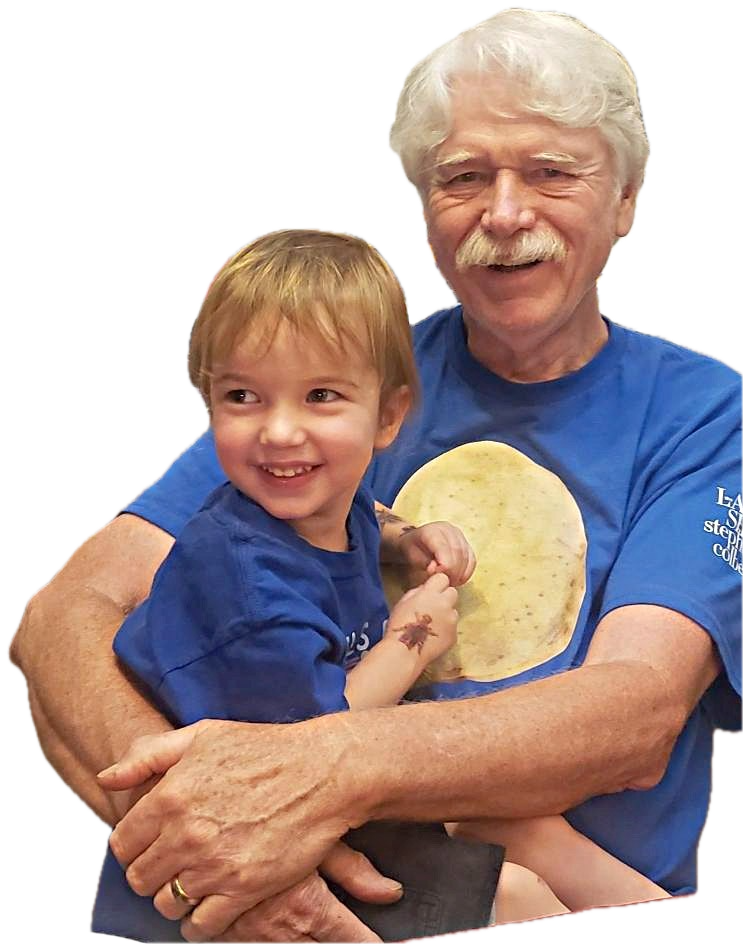
I suggested above that Bob Vernon’s career path has not taken the path of a simple, straight arrow. Fieldworking archaeologist. Volleyball coach. Expert on gunflints. Elementary school gym teacher. Computer systems analyst/administrator supporting intelligence and geospatial analysts. Technical consultant to astronomers. Mapmaker. Archivist. Grandfather. Not necessarily in that order.
So, I wondered how all those varied career skills informed the remarkable archival research Bob did into Virginia’s free Black population. To begin our conversation, I brought us back to the intellectual hothouse of a graduate program at the University of Virginia that trained us both. (Our regular faculty included Victor Turner, Roy Wagner, David Sapir, Chris Crocker, Ravindra Khare, and other brilliant anthropologists, while visiting faculty included Mary Douglas, Rodney Needham, Roy Willis, and other renowned scholars.)
Alma (AG): In this book, you’ve contributed an essay about Butler’s archival research. But, you were trained long ago as an archaeologist in an anthropology department that had more of a focus on cultural anthropology — so, you brought an intriguing set of perspectives to a historian’s work. How did that dual training shape your response to Butler’s project?
Bob (RV): In his manuscript, Reginald attempted to articulate an understanding of the dynamics of a society that today is as alien to us as rural Venezuela was from suburban United States in the 1970s. I’m not sure I was much of a student in grad school, but I suppose I was able to relate a portion of what we all read and discussed to my own demons. Internalized, the same thinking and processes for resolving my own issues assisted me in imagining and, perhaps, understanding a little how to translate the differences of lived 18th- & 19th-century experiences into ideas and processes with current meaning.
AG: So, in effect, you were thinking about the past as a cultural community, and the archives were your fieldsite. I love that.
You mentioned Venezuela as a case-in-point analogy of a society that challenged understanding because of its difference. I know that after finishing your B.A. in history from the University of Virginia, you joined the Peace Corps and spent two years volunteering in Venezuela, before you started grad school. Back in 1975, I remember you talking about your experiences in Venezuela with immediacy, as if you had just left Latin America (though you’d already been back in the U.S. for nearly two years). But since you’d joined the program in archaeology rather than cultural anthropology at U VA, I think I assumed you’d fundamentally shifted your thinking. I never asked you what you were still bringing with you to our doctoral program from Venezuela.

RV: I had horrendous reverse culture shock when I returned from Venezuela in January 1973. In one day, I went from bright blue mountain skies and a community where everyone knew me, to thick banks of gray clouds when I landed at Newark. I returned to Charlottesville after a few months reconnecting with my parents. I had friends here, and I met their friends. But I couldn’t talk to people — that is, carry on a casual conversation. I imagine I was pretty intense.
I was also paranoid when I went into grocery stores, feeling naked in public by allowing the world to see everything I was taking home to eat. Two years of small purchases at local bodegas, at the carnicero, and mercados — intimate transactions — were now public. Believe me, I did not have to read about the cultural importance of food. I’d lived it.

AG: I can relate to those feelings of disjuncture. Moving from living in small, face-to-face villages in the West African rain forest to metropolitan New York was wildly jarring for Philip and me, as well.
And, for you, the Peace Corps would have asserted its own intense realities. Had you always planned to pursue graduate training in anthropology after your Peace Corps stint?
RV: I applied for a number of jobs and eventually was offered a position with the Bureau of Indian Affairs, teaching primary school on the Navajo reservation. I was accepted into grad school at U VA at the same time. My decision for grad school was based on cross-cultural experiences I had not understood in Venezuela, and my sense that I could choose to attempt an understanding . . . or put on a blindfold and walk the same path again.
AG: How fascinating. Yet you opted for archaeology rather than cultural anthropology. I’m guessing that was because you’d majored in history as an undergrad. Archaeology and history are certainly first cousins. And you found your way back to history when you started archivally researching pre-Civil War racial lives in Virginia.
RV: In this, Reginald Butler was a great teacher. He totally reoriented my understanding of registrations, or “free papers,” from mere descriptions of height, sex, age, and physical features such as scars, hair and skin color, to a cultural context. He saw them as part of a police rap sheet, such as this one from New York. I think these insights are what we are all looking for when we try to translate from one cultural context to another.
AG: You’ve written that Reginald, himself, read anthropology while in his history graduate program. It sounds like he offered you a model of how to bring anthropological questions to the past. That’s certainly what you did in your own research, as you painstakingly pieced together families’ lives from scattered records.
But, how did you become involved in the project to publish an expanded version of Reginald’s unpublished dissertation?
RV: Reginald’s MAC hard drive crashed around 2001 or 2002, and he lost his only digital copy of the manuscript. He asked me if I could OCR a paper copy he gave me. That took a few years. A lot was happening at home and work, and the OCR’d document came out a mess. I had to correct ones and “I”s, zeroes and “O”s, set a constant font, and turn all the footnotes at the page bottoms into real footnotes. It was tedious!
[AG: OCR = Optical Character Recognition. This is a technically demanding means of recovering lost data from a computer. Bob’s amazing computer skills were clearly up to the task.]

Reginald’s Parkinson’s was worse by that time, 2005, and he was retiring. Also, somewhere along the line, he had given me a fat folder of his notes on manuscripts and digital files, with spreadsheets he’d created and miscellaneous personal notes. After more than 20 years I “rediscovered” these while writing the last pages of my essay. I didn’t even remember having them.
AG: Any thoughts on why Reginald left you all his scholarly files?
RV: I am not sure I know how to express this adequately, but this was, or became, a huge duty of trust. I do not know the source of his confidence in me. At that point, we’d known each other for perhaps six or seven years. We’d had serious, very personal, conversations about race. I have no idea what he saw in me or where his trust came from, but I felt I had to honor it.
After the gathering on the family property in Goochland County following Reginald’s passing, I approached Peter Onuf and told him I had a digital copy of the book manuscript. I emailed it to him, and he said he would have people review it. That started the process.
AG: What a beautiful story of a professional partnership, both in life and beyond.
Most scholars leave behind a lot of unpublished data that will never be available to colleagues or students. It is rare for others to wade into those deep waters and find ways to identify, re-shape, and publish the hidden gems among notes and manuscripts. I think of Paul Riesman’s magnificent ethnography, First Find Your Child a Good Mother: The Construction of Self in Two African Communities, which Rutgers University Press published four years after his untimely death at 50, with

input by his widow and former colleagues and students. You and your colleagues have done something similar for Reginald Butler’s work and have thereby assured him a scholarly legacy.
Beyond your chapter in the volume, did you have other input into how the revised dissertation took shape as a book?
RV: When Reginald became director of the Carter Woodson Institute (a year after the previous director, Armstead Robinson, died suddenly), I believe his administrative duties consumed him, and, as much as he loved it, there was no time for the book. It was a double whammy: his hard disk ground down to aluminum powder, and the job ground him down. From my perspective, it was a sad and revealing display of the academic treadmill.
I carefully read both his dissertation and the revised manuscript many times. I imagine one thing he dreaded was running down all the citations. I built a spreadsheet with a URL for each citation, making many corrections and additions. It was a horrendous grind. If the citation had a problem, I had to compare the citation in the book to the one in the dissertation. I had to carefully rewrite sections where there were major errors of fact. It seems clear to me that the dissertation was written with pencil notes for citations and that he never had an opportunity to review and correct them. When/if there is a digital edition, I’d like to see the URLs in the footnotes so that readers have instant access to the primary sources.
AG: This was such a labor of love.
In your essay, you wrote that you first met Reginald in 1995: “I contacted him to enquire about [a] court order to take a ‘census’ of free people of color” (p. 161). By 2001, you added: “I had been gathering information on free people of color in Albemarle County for about six years and sharing my finds with Butler and his students, who came to my house to work on genealogies of Albemarle families of color from the records I had transcribed” (p. 184).
So, while working as a computer specialist for the U.S. Army’s National Ground Intelligence Center, you were independently pursuing serious research about free Black Virginians. Among other exhaustive but impressive technical tasks, you detail that you photographed a large set of aerial photos and used a software platform (ArcGIS) to georegister them, digitize their property lines, and create a geodatabase, with the goal of producing an “interactive map of land ownership by race for Albemarle’s Rivanna district” (185). You then painstakingly intercalated such photos with property records, apprenticeship records, tax records, court records, and genealogies, creating tables and flowcharts to reconstruct family lives and understand the interwoven meshings of race and power. And, you’ve generously made these resources freely available to all, online. One must imagine that the motivation to pursue this independent research was personally meaningful, and that this was, essentially, a passion project. Any thoughts on where this passion comes from?

RV: How did I get into this? My mother said her father’s grandmother had “Indian” ancestry. I went to hear Helen Roundtree talk about researching Native Americans in Virginia. She said they were classified as “people of color” and registered as such. Even though genetic testing later showed no Native inheritance for my mother, I started looking . . .
AG: Searching for hidden nooks and crannies of our own identity can lead us down fascinating paths as scholars, too, right?
Toward the end of your essay, you remind us that what might appear to be trivial details can yield impactful information for a researcher who knows where to look, and what questions to ask. That’s as true of archival research as it is of research in archaeology or cultural anthropology — or, really, any scholarly field. You write: “details might be found in the archival weeds, but one person’s weed is another’s flower when it blossoms into an understanding of personal motivations underlying documentary records.” Here, you are clearly giving more than a passing nod to the interpretive tools of cultural anthropology that you learned in our graduate program.
And, taking your pedagogical point further, I love how you end your essay, urging students to “look beyond the confines of canonical texts in their discipline broaden the scope of their inquiries, and seek explanations that enhance their own understanding of the past” (188).
That seems a good place to end our conversation!
BONUS:
On January 23, 2026, a day-long, hybrid-format symposium in honor of the life and work of Reginald D. Butler will take place in Charlottesville. Bob Vernon and the others involved in the production of Butler’s landmark book will participate. It promises to be, at once, an enlightening and moving event. You can register for the in-person event here; or register for a Zoom link here.
*
P.S. As we finished this conversation, we learned that Donald Trump had invaded Venezuela. Having lived in that country for two years, Bob would, I knew, have many insightful comments.
AG: Any quick thoughts?
RV: The snatching of Maduro is indicative of a fundamental misunderstanding of the political reality of Venezuelan politics.
Maduro was not so much the head of government as he was one leg of a triumvirate that distributes booty derived from governing. Maduro and siblings Delcy and Jorge Rodriguez represent the symbolic legacy of Hugo Chávez as heads of the United Socialist Party of Venezuela. They maintain power and influence by distributing positions and benefits to loyal party followers. Vladimir Padrino López is the Minister of Defence and is responsible for military support of the government. Diosdado Cabello Rondón is the Minister of Interior and a hardline enforcer of state authority through an extensive patronage network that includes connections to colectivos, the motorcycle gangs that terrorize citizens, and drug trafficking organizations. He is, perhaps, the most dangerous man in Venezuela. Political power is balanced between these three factions, any two of which can assure the loyalty of the third.
Trump’s understanding of the nature of political power in Venezuela should have been informed by a political anthropologist, or anyone else familiar with the history of triumvirates. The power wielded by Padrino López and Cabello suggest that the removal of Maduro followed by threats to Delcy Rodriguez will be insufficient to “run” Venezuela.
I’ve been in contact with a few friends in Venezuela. Even the most anti-Chavista question, and are affronted by, this intervention. What will these actions cost the two countries, and what terrible precedents do they set for international relations and the importance of honoring the Constitution that established our republic?
Imagine the capriciousness of a presidential kidnapping, with no serious thought of what follows. And to that, add glib lies and egocentricity. “Donroe Doctrine”?? Really!